
Nurses Fob Watches: What to Look for and Why They Matter
Range update: FOB & Co no longer sells nurses fob watches. This article is an informational guide. Our current pocket watches are gifts and personal accessories, not a replacement for a workplace-approved clinical watch. Check your employer’s requirements and the watch manufacturer’s care instructions before choosing a watch for work.
What Is a Nurses Fob Watch?
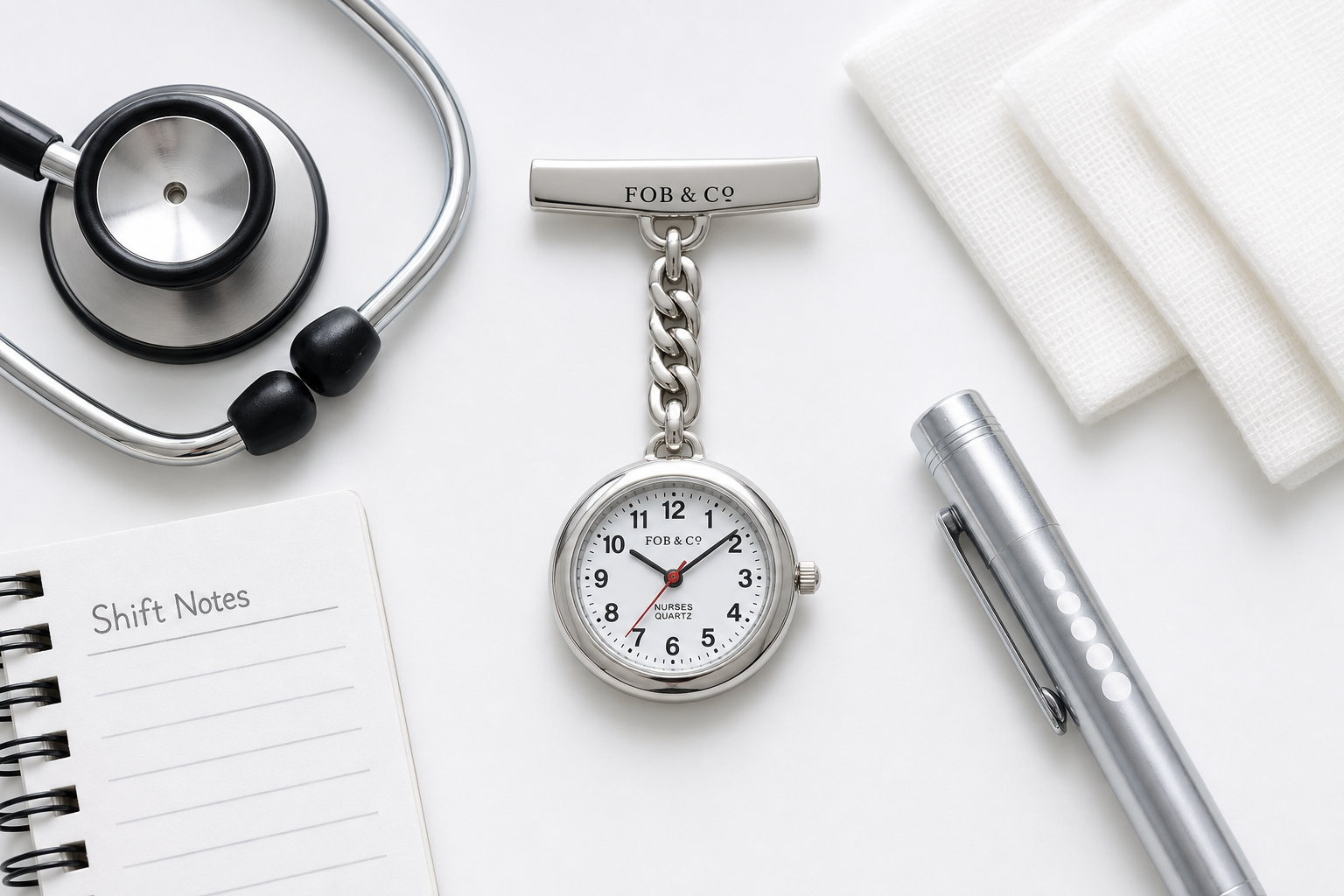
A nurses fob watch is basically a small pocket watch built to clip or pin onto a uniform rather than sit on your wrist. It hangs from a short chain or a retractable reel, usually tucked into a breast pocket or clipped to a lanyard, so the face flips out when you need it and tucks away when you’re elbow-deep in a dressing change.
The reason this style exists at all comes down to infection control. Most Australian hospitals follow “bare below the elbows” guidance, which means no wristwatches, no rings with stones, and sleeves rolled up during clinical care. A wristwatch sits right where hands are being washed forty times a shift, and the strap becomes a place for bacteria to hide. Pin it to your chest instead and that whole problem goes away, which is exactly why the fob watch has stuck around in nursing for well over a century even as regular wristwatches have gone digital and disappeared into phones.
There’s also a practical side that has nothing to do with policy. A fob watch sits at chest height, upside down from your perspective, which is deliberate. Read it while it’s hanging and the numbers look backwards. Lift it towards you (or just glance down) and it reads the right way up, quick enough to check while you’re mid-conversation with a patient. It’s a small design detail but it’s the difference between a watch that’s genuinely useful on the ward and one that’s just decorative.
For clinical use, compare dedicated nurses-watch suppliers and check your workplace requirements. FOB & Co’s current range does not include nurses watches.

How to Choose the Right One
Start with the dial, not the case. You’re going to glance at this thing forty or fifty times a shift, often in a dim room at 3am, so a cluttered face with tiny numerals is going to slow you down every single time. Look for a plain white or cream dial, bold black numerals, and a second hand that’s easy to track, because counting a pulse or a respiration rate off a vague sweep hand is genuinely annoying when you’re three hours into a night shift.
Next is the attachment. Most fob watches come as either a pin-back (a small brooch-style pin through the fabric) or a clip with a retractable reel, similar to what you’d see on an ID badge. The reel style is more forgiving if you’re changing scrubs often or moving between wards, since it doesn’t leave a pinhole in every uniform you own. The pin-back tends to sit flatter and looks a little neater if you’re wearing it for a ceremony, graduation, or a more formal role where appearance matters more than quick access.
For clinical use, compare dedicated nurses-watch suppliers and check your workplace requirements. FOB & Co’s current range does not include nurses watches.
Battery vs mechanical movement
Quartz (battery) movements are the practical choice for clinical work. They keep near-perfect time, need almost no maintenance beyond a battery swap every year or two, and don’t drift the way a mechanical movement can if it hasn’t been wound. Mechanical fob watches are beautiful and there’s a real romance to the ticking movement, but if you’re relying on it to time a set of obs at 2am, quartz is the safer bet.
Top Styles and Options
For clinical use, compare dedicated nurses-watch suppliers and check your workplace requirements. FOB & Co’s current range does not include nurses watches.
For an off-duty graduation or retirement gift, browse Engravable Pocket Watches. These are keepsakes for personal use, not nurses watches for clinical work.
For an off-duty graduation or retirement gift, browse Engravable Pocket Watches. These are keepsakes for personal use, not nurses watches for clinical work.

What to Consider Before You Buy
For clinical use, compare dedicated nurses-watch suppliers and check your workplace requirements. FOB & Co’s current range does not include nurses watches.
Hygiene is the other consideration that catches new nurses out. Fabric or leather straps have no place in clinical settings because they can’t be properly cleaned, and the same logic applies to the fob itself. Look for a smooth metal or silicone-backed case that can be wiped down with the same alcohol wipes you’re already using between patients. If your ward has a strict infection control policy (and most do these days), ask your infection control lead what materials are approved before you buy, because policies do vary slightly between hospitals and even between wards in the same building.
Think about where you’ll actually clip it too. Chest pocket, lapel, or on a retractable reel next to your ID badge are the three common spots, and each has trade-offs. Chest pocket keeps it protected but can be slower to reach if you’re gowned up. Lapel and reel positions are faster to glance at but more exposed to knocks. If you wear a lanyard with other tools on it, check the fob watch’s chain isn’t going to tangle with your pen, scissors, or badge reel, because a watch reading 20 minutes fast because it’s been yanked around all shift is worse than no watch at all.
Tips From the Experts
Nurses who’ve been through a few of these watches all tend to say the same things once you ask them directly. First, buy a spare battery or keep a note of the battery size the first time you replace one, because standing in a jewellery shop trying to remember whether your watch takes an LR44 or a 377 is a waste of everyone’s time.
Second, wipe the fob watch down at the same time you’re doing your own hand hygiene between patients where practical, not just at the end of a shift. It sits close enough to patients during observations that it picks up the same contact risk as your hands do, even if policy doesn’t explicitly require it.
For an off-duty graduation or retirement gift, browse Engravable Pocket Watches. These are keepsakes for personal use, not nurses watches for clinical work.
Finally, don’t overthink the styling. The nurses who get the most out of their fob watch are the ones who picked a plain, legible dial and a sturdy attachment over anything flashy. You’ll be checking it hundreds of times a week for years. Clarity wins over novelty almost every time.
Frequently Asked Questions
What is the best nurses fob watch?
The best option is usually a plain white-dial watch with bold numerals, a clear second hand, and a stainless steel case that can handle daily wipe-downs. Beyond that it comes down to whether you prefer a pin-back or a retractable reel clip, since both attach securely but suit different uniforms and workflows.
How do I know which nurses fob watch is right for me?
Think about how you move through a shift. If you’re gowning up and down often, a retractable reel clip is faster than a pin. If you want something neater for a ceremony or a more formal role, a pin-back sits flatter against the uniform. Either way, prioritise dial clarity and a quartz movement over anything decorative.
What should I look for when buying a nurses fob watch?
Check the dial is easy to read at a glance, the case material can be cleaned with alcohol wipes, and the attachment (pin or clip) feels secure rather than flimsy. A reliable quartz movement is worth more day to day than any amount of styling.
Are there budget-friendly nurses fob watch options?
Yes, and you don’t need to sacrifice quality to get one. Compare dedicated nurses-watch suppliers and confirm the watch meets your placement requirements. FOB & Co no longer sells this range.
References & Sources
- Infection Prevention and Control — Australian Commission on Safety and Quality in Health Care
- Clinical Topics — Royal College of Nursing
- Hand Hygiene in Healthcare Settings — CDC
For personal wear or a keepsake outside work, explore Vintage Style Pocket Watches and Engravable Pocket Watches. These collections are not offered as clinical nurses watches.